Navigating perimenopause body struggles can leave you feeling disconnected from yourself, especially when unexpected midlife weight gain and body changes shift how you view the mirror. In this post, I share my personal journey through body dysmorphia, high-intensity exercise burnout, and the exact steps I took to embrace my changing body during perimenopause without guilt or restrictive dieting.
My Lowest Point: Skin, Bones, and a Fake Smile
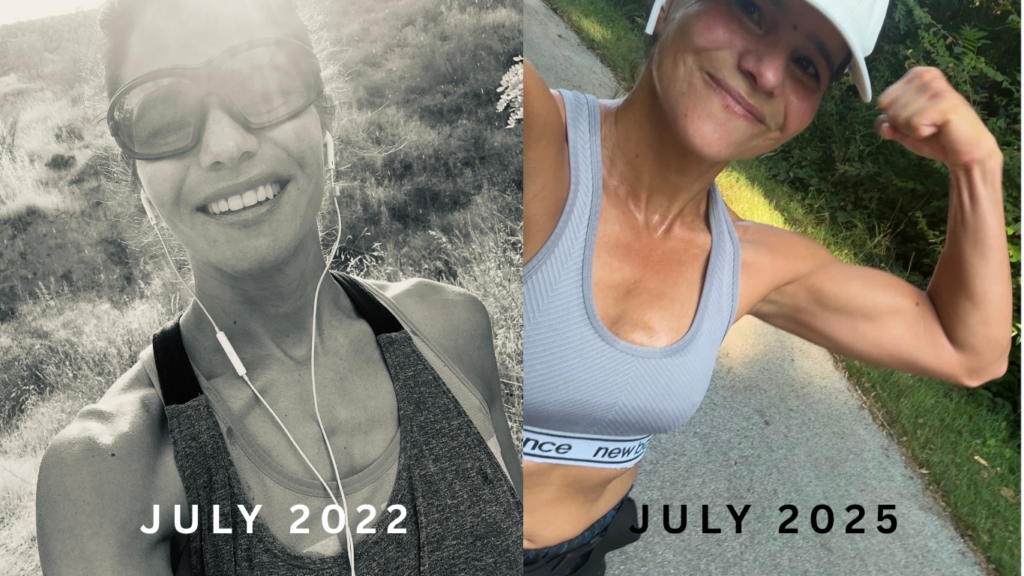
I posted the above picture of myself on July 5, 2022.
I was under 110 pounds at 5’3″. (Back then I never weighed myself because it always triggered issues, but I know I was under 110 because a few months later after gaining weight, I finally stepped on a scale and it said 111). Visibly I was all smiles and bones for the camera that day. I was trying my absolute best to look happy and healthy when the reality was that it was probably one of the lowest points of my adult life. I was trying to recover from an extremely toxic relationship while still carrying heavy guilt over the separation from my nearly 20-year relationship.
All my life, I wanted to be thin. But I was blessed—or as I saw it for years, cursed—with a naturally muscular body. My mom said that when I was born, I popped out feet-first with muscles.
The Roots of Body Dysmorphia: Gymnastics to College Binges
Growing up, I was a total tomboy. I ran with my big brother, arm-wrestled kids at school, outran everyone in my class, and was even put on my older brother’s soccer team—much to his utter embarrassment—because I was fast and fearless.
At a very young age, I started tap, ballet, and gymnastics at a small local studio. It was run by a very thin ballerina who told my mom I’d never do ballet professionally because I was “too dark and not thin enough.”
Unfortunately, I heard every single word.
I shifted focus to gymnastics and loved it. Every day after school was spent at the gym training to compete on weekends. I grew up alongside the other girls my age; we celebrated birthdays at the gym, had sleepovers on the mats, and talked about boys, periods, and boobs. But for some of us, puberty hit later than others. Our physical development—or lack thereof—was certainly not helped by high-intensity training, nor by coaches reminding us that staying thinner meant staying lighter and more agile. Eating disorders, body dysmorphia, and constant injuries became standard conversation among us.
By high school, I decided I was done competing. I wanted to be a normal teenager, hang out with friends, and just exist. Unfortunately, stepping away meant weight gain, curves, and getting my period at 14. I struggled with the change. So, I threw myself into track, cross country, tennis, and any other sport I thought would keep me in shape—never because I actually enjoyed them. I also became a vegetarian (or rather, I just stopped eating meat and most other things) not out of deep compassion for animals, but because I thought it would make me thin.
Then came college. I started partying, eating cafeteria food, and gained the classic Freshman 15. To combat the eating and drinking binges, I became bulimic. I kept playing sports and going to the gym to force the pounds off, but living in the Midwest with those long, freezing winters didn’t help. During those years, whenever life felt hardest, my coping mechanism was simple: eat less, work out more, drop weight, and lose my period entirely.
Finding Freedom in Spain—and Slipping Back into Old Habits
At 19, I went to Spain for the first time. I was still a vegetarian, but at a normal, healthy weight, and for the first time in a long time, I felt content in my skin. By then I had started eating meat again, fell in love with fresh fish and local produce, and adapted to the Spanish rhythm of living—heavier lunches and light, slow dinners. I walked everywhere. I picked up outdoor sports I’d never tried before: rock climbing, mountain biking, hiking, and trail running.
Eventually, I moved to Spain full-time, and my active lifestyle exploded. Over the years, I was doing 8 to 10-hour adventure races, 5-hour mountain bike rides, and running trails for hours. I tried kayaking, downhill skiing, cross-country skiing, parasailing—you name it, I tried it. I stopped worrying about the scale and started actually enjoying my strong body for allowing me to play like that.
In 2019, a life-changing experience hit, and my old insecurities crept right back in.
I carried shame and guilt around like a heavy backpack, and it kept me from looking in the mirror and seeing the person staring back. Instead, I slid right back into old, destructive habits. I allowed myself to stay in toxic relationships because I quietly believed I didn’t deserve better. I started working out to extremes again, fasting for 16 to 20 hours a day, and cutting out almost all carbs.
By 2022, I hit rock bottom. I couldn’t bear to look in the mirror. I was the thinnest I had ever been in my life, disgusted by it, yet secretly feeling like I deserved the punishment. My health was the last thing on my mind, and looking back now, I was in a genuinely dangerous place. My hair was falling out, my nails were brittle, I woke up soaked in night sweats, I never slept more than 5 hours, and I lived with constant, buzzing anxiety. Without realizing it, I was at risk from myself.
At the end of July 2022, my best friend came to visit me in Granada, and we took a planned trip to Ireland. It was my saving grace. She pulled me out of my toxic environment and got me back to traveling—one of my favorite things on earth. I started noticing beauty around me again. We ate incredible local food, explored new places, dressed up for a wedding, and slowly, I started recognizing the person in the mirror again.
My trip ended in the U.S., and while my struggles didn’t magically vanish overnight, I began to heal. When I weighed myself that September, I was 111 pounds. By the time I flew back to Spain in October, I was 116. I was finally on my way back to health.
Accepting Midlife Weight Gain and Adapting to Perimenopause
Over the next few years, as I transitioned back to living full-time in the Midwest, I had to relearn how to love myself and treat my body as a gift.
Since that 2022 photo, I have steadily put on weight. Unhealthier local food options, a more sedentary lifestyle, flat paved paths, and perimenopause are my new daily reality. Adaptation and acceptance have become my new tools.
- My old 5-hour bike rides are now 1-hour spin classes at the gym during winter.
- My 3-hour trail runs are now walks—with the occasional jog thrown in—while listening to educational podcasts about women navigating midlife.
- The gym is my winter haven, where I lift weights and marvel at the woman in the mirror who is no longer skin and bones, but muscle and a genuine smile that reflects who she is on the inside instead of hiding it.
Now, is it always as easy as “just accept and adapt”? Hell no.
This summer, a brand-new belly made itself right at home and clearly has no plans of leaving anytime soon. And what did I do initially? I slid right back into shame. I started wearing one-piece bathing suits, avoided going to the pool, let my self-talk turn negative, and secretly wished to be skinny again.
Until that July 5, 2022 picture popped up on my feed.
It reminded me of the hard truth: being thin never made me happy.
So today, I went out for a walk. I enjoyed the crisp summer morning air and picked up the pace to run off and on. I stopped to take a picture, looking at myself through the lens to see what everyone else sees. And I saw a smiling face, rosy flushed cheeks, muscle and skin covering bones, and a strong, deeply healthy woman.
The Truth About Perimenopause Body Dissatisfaction
Research shows that between 8.6% and 20% of women experience a clinical eating disorder in their lifetime. But broader body dissatisfaction and subclinical disordered eating behaviors—like chronic meal-skipping, obsessive restriction, or over-exercising—affect anywhere from 60% to 89% of women during midlife and the menopause transition. Metabolic shifts, weight redistribution (hello, midsection!), and dropping estrogen levels amplify body distress, with up to 80% of midlife women actively trying to lose weight or feeling negative about their changing bodies.
We aren’t failing; our bodies are adapting. Here is how I have personally adapted my life to perimenopause and my new surroundings.
I have started “microdosing.”
I’m microdosing life, activity, exercise, food, alcohol—and drastically cutting back on spending time doing shit that sucks with people who suck.
My Current Adaptations:
- Smarter Cardio: No more 5-hour bike rides or 3-hour runs on an empty stomach. Now I take walks or short, light runs, listening to empowering podcasts instead of high-tempo music meant to distract me from physical pain.
- Intentional Strength: I hit the gym in the winter, but instead of lifting heavy 5–6 days a week until I’m sore for days, I lift a few times a week within a challenging range that doesn’t make standing up from the toilet an ordeal.
- Balanced Nourishment: I eat out regularly, but I choose healthier menu options, split meals, and consciously moderate my alcohol.
- Hard Boundaries: I am done saying “yes” to everyone else’s demands. I no longer do things just because I think I “should.” I’ve started saying no to others and a resounding YES to myself. I seek out downtime and actually enjoy it—reading, listening to music, taking a long shower, getting a massage, or sitting in the library without an ounce of FOMO or guilt.
Reclaiming Strength: My Midlife Non-Negotiables
Things I’m Still Working On:
- Kind Self-Talk: Reminding myself that my words are my wand.
- Mirror Work: Looking at myself in the mirror and intentionally complimenting the parts of my body I love.
- Self-Compassion: Embracing my strength and accomplishments, and giving myself grace when things don’t go as planned.
My Non-Negotiables (No Matter What Phase I’m In):
- Journaling: It sets my mindset, grounds my day, and reminds me how privileged my life really is.
- Regular Movement: My energy is naturally high, and movement keeps me grounded—even if the intensity changes.
- Lifelong Learning: I am always taking a course, reading a book, or attending a workshop.
What You Will NEVER See Me Do Again:
- Obsessive Tracking: I will never count calories, track macros, weigh my food, or eliminate an entire food group again. I believe in variety and trust my body to signal what it needs.
- Judgment: I won’t criticize, judge, or minimize other people and their personal struggles. We all have our own, and I refuse to waste my energy putting others down.
Reclaiming Your Life: Why It’s Time to Take Off the Cape
Why am I sharing all of this right now?
Because as women, we are conditioned to smile at everyone, wave off concern, and say, “I got this,” “I’m okay,” or “No, I don’t need any help.” As we age, we stack more and more onto our plates. Everyone around us starts viewing us as superwomen, putting even more pressure on us to never take off the cape.
My story isn’t any different from the millions of women currently navigating perimenopause and midlife. But for the first time in my life, I am realizing something important: I do need help, I want help, and I am finally prepared to ask for it.
What does that help look like? To the outside world, it might look like me being “selfish.” But in reality, it is me strengthening myself so I can move forward with a healthy body and a clear mind.
So here is my challenge to you: Take care of yourself so you are actually healthy enough to keep showing up for the life you want.
Take time off. Take real downtime. Listen to your body. Talk openly to other women. Book the retreat. Take the mini-vacation. Shut the door to a quiet room and just breathe.
And whatever you do—do NOT feel guilty about a single second of it.